If the taxi trip from Agra to Delhi yielded anything interesting, anything at all apart from mile after mile of village dotted arid scrub land, then I'm afraid it rather passed me by. The road and the miles slipped on by with only the occasional body numbing jolt to break the monotony. All four of us took to playing Risk on Ewan's I-phone to pass the time. Dom, never having played the game before, found himself to be disturbingly good at it and so the six hour drive passed relatively quickly and uneventfully as we all tried to figure out how to stop him winning for a fourth game in a row.
In the background, and slowly as if creeping up on us, Delhi announced itself with gradually increasing traffic and a selection of wide open, decently maintained tree lined streets that stretched themselves into the distance. If Mumbai, Jaipur and Agra had shown us three different India's so far then Delhi must be the fourth point of that same compass. A city with nothing to contain it, the commodity that Delhi does best in is space. Everywhere you look there are wide streets, squares, parks, shopping malls and clear skys.
Out taxi deftly navigated us through the traffic to our overnight stop in Delhi, the Prince Polonia hotel. It appeared electrical fire free, so we accepted it as an improvement on Agra, dropped our stuff, asked the hotel to book us a train to Kalka for the following day and set out to see a little of the city.
Delhi had never really been a major stopping point on out trip, more of a rest stop as we plough on north into the Himalayan foothills. While it's the capital of India it actually offers surprisingly little in the way of new experiences or cultural insight. In fact in many ways it's exactly like any of the major European cities with nothing but the traffic and the heat to set it apart. All the shops sported western brands, levis, reebok, nike, and so did the people shopping in them. Even, for once, the prices were similar to those you might find in the UK.
For dinner we had the choice of italian, Spanish, Chinese, and about ten other nationalities of food and we, only semi accidentally, ended up in a Mexican restaurant where the waiters wore cowboy hats and boots and Totenham were playing Stoke on the plasma screen tv. Delhi didn't really feel like India at all. Absent was the hassle. Absent were the beggars and absent were the crushing crowds of people. Absent were the piles of rubbish and absent were the funny smells. Absent were the street markets and the shanty houses. Absent were the potholes and absent were the cattle herders in the street. In their place was Delhi. A modern city. And that about sums it up. Our train was booked for the following evening and none of us had any regrets that we had no more time to spend looking around. Would we come back to Delhi? Yes, but we'd bring something to do with us.
***
It turns out that to bring out the true Indian culture in Delhi requires a morning, a brief wander, and a visit to tourist information. A grubby looking building hidden away on a side street one might be forgiven for thinking the official government tourist information centre was just another white goods store on a random street in Delhi. But a little sign in the window and above the door announced it's true identity and we all pressed ourselves inside in the hope of planning out our next few days.
All in all I rank the experience of sitting in that tourist information office as one of the most thouroughly confusing and socially unbalancing experiences in my life to date. Two men appeared almost instantly by our sides. Two such different men as it would be hard to imagine. One tall and thin, a smiling face under a big black beard wearing a casual t-shirt and jeans who approached us with open arms and greeted us in a ridiculously high but husky voice, like someone who's just about to lose the power of speech, or someone who's just got it back. The second man was short and rotund, clean shaven with very little hair at all to be seen and a gruff business like manner which all but saw us pushed us into his office without even the chance of a backwards glance.
"Hello," said the first, "my name is Touramassaratal...." and at that point we all looked at him incredulously as he reeled off a further 16 syllables before stopping. There was only a moments silence before, cool as you like, Dom went right ahead with, "sorry could you repeat that?" and recieved a second soundbyte that confirmed to all of us that we stood no chance of ever even repeating this name let alone remembering it. Unfortunately, etiquette dictates that after you've asked for, and recieved, three repetitions of a name in a row, you have to stop asking and just give it a shot with whatever you can remember. The look on Doms face rather revealled that he knew that very well, and after pushing for a fourth repetition the rest of us sat back to see if he would a) give a valiant but plainly hopeless attempt at pronouncing the name, b) ask for what would be an incredibly awkward fifth repetition, or c) nod politely, say "nice to meet you" and try to move on quickly.
"Touratala..." oh dear. Gales of laughter so husky it could pull a sled. Infectious as well and we all found ourselves joining in. The man sounded extactly like mutley.
"Touramasat... Toramattalan... Touritasal... he waved at Dom to stop from behind a wide grin.
Leaning in conspiratorially he said quietly, "it means, the man who is the person who makes everybody smile." The rest of us laughed as Dom tried to make out that he of course knew very well that that wasn't his REAL name and the conversation moved on with all of us looking at each other smiling awkwardly.
And then the other, rounder gentleman told us that our hotel had charged us double for our train tickets, that we should cancel them as soon as possible, and the smiles disappeared.
I wont go into the details of what was a very long and in depth conversation about just how our hotel had swindled us. The rotund man rattled on at a hell of a pace, tapping away at a computer older than the building it was in and showing us screen after screen of numbers and train timetables. There were numbers we could call and companies we could chase up and so on, and on, and on. We all listened as closely as we could, slowly growing more and more incensed as it became obvious that our hotel had played us for the tourist fools we were. It's true that when in India you always find yourself playing a game of 'who to trust most', but a government tourist information official backed up by the official Indian railways website is hard to argue with. Especially when your train ticket has, clearly marked on it, that it's gone through a package tour operator you've never heard of for a cost of 300 rupees apiece.
Now £4 each is not a massive amount of money to be cheated out of I grant you, but it was more the principle than the cost that made us cancel the ticket, and by this point we were starting to think that the train might not be the best option anyway. At this point our keyboard bashing friend was outlining another, much more expensive, better, but more expensive, more reliable, but at the end of the day slightly more expensive option. An option which, funnily enough, we now needed because we'd gone right ahead and cancelled that train ticket.
"Do. you. like. fishing?" inquired a pair of massive bushy eyebrows from the doorway. All of us turn and wonder if we are going to have to pronounce the names of fish now.
"I can get any fish I want." said the eyebrows suggestively. "you want me to teach you?" His nudge nudge wink wink manner made it painfully obvious that we were now involved in the kind of extended fish metaphor that none of us could possibly have anticipated.
"Er..."
"Each fish is different, you have to use a different line on each one, but for every fish there is a line that will work. You know?"
We all clearly responded in the affirmative.
"Aaah you see you know! This way you can catch lots of fish. Just using the right line!" said the eyebrows, dancing disturbingly.
"What do you fish for?" said Tom in an attempt to break free from a bad metaphor.
"Trout." said the eyebrows.
"Ah. Well. Ok then." A pause. "We don't like trout really do we guys?" We all shook our heads. "We more prefer...err...well...." Tom was struggling, "Cod?"
"Women," interjected Ewan.
"Yes. Women." we all agreed. This conversation was, if such a thing were possible, getting stranger.
"I have caught many a trout you know?" he extended the word know for far too long and then started laughing while making playful winks at us. "I used a different line for each one, tailor made for the time you know?."
"You should just use a net," I said. "It'd be more efficient if you want to catch lots of trout." Pretty much I was taking the fish metaphor and running with it. But eyebrows didn't seem impressed.
"No!" he cried in mock despair throwing an arm around my shoulders and turning to the others with a pleading look. "A net!? No! You guys have to teach him you know?"
At this point Tom, Dom and Ewan were struggling to hide laughter as they watched me gently and surreptitiously try and duck out from under the arm. But all of them nodded their agreement.
"You see!!!!" sad eyebrows turning on me. "You don't use a net! Promise me you won't!"
"Oh.. OK...." I stammer before Dom helpfully interrupted with, "He already has a girlfriend." Eyebrows looked at me incredulously.
"You have a picture? Of course you do. Show me show me." I obediently got out a picture and showed it to him. He glanced at it for a second.
"She's not my type," he handed the picture back abruptly, leaving me once again grappling with a conversation that didn't seem to follow any of the normal rules.
"Well she is mine? I assume I'm allowed to think that?" but eyebrows was no longer listening.
"You want to see a proper girl? Here." he flipped open his wallet to show a girl who, with all the best intentions, looked quite a lot like a trout.
In a quite touching display of solidarity all of us at the same time declared that she was "not our type". But eyebrows didn't seem to register anything, he just took the picture back and walked towards the door with that huge grin still fixed to his face.
"You wouldn't get that with a net!" He shouted over his shoulder as he left.
We turned back to the man at the computer who was wearing a beautiful expression which said "please just do as I tell you and pay me money before he comes in again." So that's exactly what we did.
***
Once again we found ourselves in a taxi driving north. Once again risk was keeping us entertained. And our new driver was called Kaka, which thanks to a rather famous Brazilian footballer, we all found, for once, easy to remember.
The road north out of Delhi is a massive eight lane highway spoilt only by the roadworks spread right along it's length. Periods of easy running on flat Tarmac are sporadically broken as four lanes cram down to one dirt track and everyone swerves right off the road to avoid the massive rises of earth and machinery. These regular lane squashings seem to provide the Indian drivers with a much needed opportunity to exercise their horn skills, and everyone merges together onto the track without even slowing down.
The horn in India is a completely different beast to the horn in the uk. In India a short blast on the horn hides a whole language of different meanings depending on the situation. It can cover everything from "get out of my way" to "hello please don't crush me", from "I'm just about to undertake you at speed" to "watch out! Your cow is in the wrong lane." It's used at a standstill and at 90 miles an hour. It's used when the car ahead is clearly unable to move due to traffic. And it's used when there are no cars ahead, just to make sure it stays that way.
All the big lorries that crowd the near lane have "blow horn" painted onto the rear doors. The idea stems from the fact that nobody here ever checks their mirrors before pulling out of their lane. The blind spot on indian cars is everything not through the front windscreen. If you don't blow your horn when overtaking a truck it's liable to pull out for no reason and crush you, and the truck driver will argue that if you didn't want to be crushed, you should have made a noise.
Kaka, thankfully, had absolutely no trouble using his horn and so for the long drive up to Chandigarh where we were staying the night, crushing was avoided at the expense of our ear drums.
Settling down for another single night stay at yet another hotel it was odd to reflect that earlier that day the plan had been to get a train from Delhi. Somehow that seemed a long time ago. But in the end everything had worked out well enough so far. We even had pre-booked toy train tickets for the next day. The 5 and a half hour train had ended up costing us less than a pound each.
At that cost we would happily have paid double. But we thought it best not to pry too deeply into our expenditure this time around. Just in case.
George
Tuesday, 4 October 2011

Tuesday, 27 September 2011
The Taj Mahal
Day 18
Departing from the dreaded Hostel Nirvana we found that in fact they'd trapped us in. The large gate was locked with a padlock so the only option was to scale the neighboring walls. Tom, Dom and I chose the shoulder height wall perpendicular to the gate. It had a ledge on the opposite side which we could quite easily use to step onto the dusty street below. George however decided that the shoulder height wall was insurmountable, and chose the slightly lower wall to the right of the gate. Tom, Dom and I watched on as he straddled the wall, only to realise that the drop was higher than he imagined. He proceeded to make a pigs ear of his decent to earth. With a lack of grace that would have had Ganesh flapping his ears in disgust, and simultaneously had us crippled with laughter as we watched on, too occupied to help, George slid down the side of the wall. Awkwardly he touched ground. "I thought it would be easier", he confessed, looking at his grazed palms. Tom produced a med kit; fixing George up with a plaster and some friendly mockery.
The comedy continued as we witnessed two frisky dogs going at it in the middle of the road. We left them behind with a few 'doggy style' jokes, pressing on for the Taj Mahal.
It was just past sunrise when we arrived. As we got there so early the queues hadn't yet formed but we had a minor setback when security refused to let me in with my bag, which was 'too big', George's dice and cards, incase he 'played with them', and Tom had to debate that infact his much smaller bag was perfectly fine...
The hassle was worthwhile. Our quartet stood awestruck at the mighty Indian landmark. Towering with an imposing beauty against the blue sky, the Taj Mahal affected us all. It's white dome reflected with a peaceful stillness in the shallow waters of the grounds. Just like the Eiffel Tower, Statue of Liberty and the Sydney opera house, the Taj Mahal is so recognisable; iconic of it's native India.

It was this fact that affected me most of all. I'd walked to the site expecting a bit of an anticlimax. For some reason I assumed it would be over-hyped, just a boring building that for some reason people flocked to visit, a result of it's picture book fame. My cynicism was unfounded. I suddenly understood that it deserved its fame. For some reason it had me hooked. It's difficult to describe how it felt but there was almost a mystical aura, gripping me with it's own tranquility.
More tourists start to appear and before long, a free-for-all photographic brawl broke out. All the tourists, both foreign and Indian, attempt to muscle their way to the front to get the classic photo. Everyone wants to pose in front of the impressive building (including us)!
We wandered along the grounds and I started to take some more alternative photos. The vast crowds and excited tourists made for some great photographic opportunities so I tried to capture the mood. I managed to film a bit too, although the intense sunlight made for harsh contrasts between the light and the shadows. Having no sun-guard for the LCD screen meant that for some of the time I was filming blind as well. Therefore, I found still image a much better way to document the visit.
The Taj Mahal stood tall and proud on an elevated stage. Like bishops on a giant chess board, columns stood at all four corners, guarding the main mausoleum. Waiting in the wings were two symmetrical red stone structures with many pillars. One of which was a mosque . The River Yamuna flows past in the shadow of the dome, making for an impressive backdrop to an altogether breathtaking scene.
Built in 1653, the main mausoleum was built as an elaborate tomb for Mumtaz Mahal by Mughal emporer Shah Jahan. You can go inside. There was an amazing reverberation of sound, as the voices of tourists bounce around within the giant dome; it made for an eerie soundtrack.
The inside was disappointingly neglected compared to the immaculate exterior. There was even a bit of graffiti in one place. It's surprising how somewhere with such laborious security measures at the gates, fails to guard the actual building itself. I took a soundbite and left.
I made sure I got to sit down and just take in the whole picture. Plugging in my iPod, I sat absorbing the scene, watching all the people pointing their many cameras Mahal-wards. Muse's Exogenesis plays in my ears. Total relaxation.
Ewan
Monday, 26 September 2011
On The Road Again
Day 18
An early start for all of us today, but Ewan, Dom and I made it to breakfast for some pancakes. After finishing my sugared omelet we thanked the proprietors of the Laxmi Palace for an awesome stay. We had a driver booked for the next few days to drive us to Agra and then on to Delhi.
We set off from the bumpy streets of Jaipur city just waking up. We soon made it to a duel carriageway where finally smooth tarmac and actual road signs were a pleasant change. This was not long lived. Our 240km taxi to Agra posed us with many dangers. Deep holes, excavations really were dotted along the duel carriageway. In some places there were random speed bumps in a 90km per hour designated speed zone with no prior warning. Farms herded their cows and goats alongside the road and more were being transported in trucks.
Motorists didn't seem to abide by the white center line road markings with some even going against the traffic with only a horn to protect them. We followed a truck that struck a wandering cow on the road. It was split from the herd on the central reservation and was still alive but immobile as we swerved to avoid it. Further along there were lanes blocked by truck drivers either swapping spare wheels or stopping to sit in the shade, oblivious to their tying up of one side of the carriageway.
60km outside Agra we stopped to stretch our legs. Keoladeo National Park seemed like a perfect place. Tranquil surrounds of grass and marsh and a place where no motor cars were allowed to enter was a pleasant change from the dusty streets of the days before. We hired old, battered and frankly uncomfortable push bikes to enjoy a sociable ride in the midday sun. We acquired a guide too, a naturalist, very knowledgeable and a very good spotter. Even with the goofy teeth that stuck out further than his chin he spotted some unbelieveable things. We caught a glimpse of an owl sleeping up in a palm tree and submerged turtles with his keen eye to help us.

The park also had many other species in their element. stalks in mating season and nesting in the park. We saw butterflies, dragonflies, kingfishers, pond herons, indian robins, doves and bluejays. Bee eaters were also in abundance with lots of food on offer as many trees had colonising beehives. We stopped at a checkpoint to enjoy another drink, much needed in the burning sun.Campa, another brand of coke, was all that was on sale, so we went with it and carried on through the bush.
Several crashes from George later and our cameras packed with photos of a parakeet porno we headed back for food and finally a comfy seat. Indian roadside meals left a lot to be desired as we found in a dark and dingy indian Little Chef equivalent where we had perhaps the worst meal since the Mumbai train. Cheese on toast really was cheese on toast. Not melted cheese or even warm toast but I needed the calories after our three hour bike ride.
We crossed several toll booths over the state line. The cars now read "UP" on the number plates but the "RJ" of Jaipur's cars were still on the road, in a traffic jam as we were. Luckily I was asleep for this and missed the rest of our trip through the outskirts of the city.
The center of Agra was again different, cleaner again and more westernised. More adverts were on billboards shops and cars and every shop seemed tourist orientated. The signs and road marking still remained right into the city center so at least we could roughly find our bearings.
We arrived at our hotel finally after our driver had asked several bystanders for directions. The wait was not worth it as we arrived into an abysmal hotel, God knows how Hostel World even endorse it let alone give it a good rating. There was a gecko in our air con and millions of flys he could feed on. The reception was dark damp and smelled. We had to remove our shoes, God knows why, maybe so we cleaned up the ants as we walked. We sat in the room and couldn't wait to leave. Ewan was electrocuted in the shower and there was a socket hanging from the wall where there had obviously been an electrical fire.
We decided to take refuge in a Pizza Hut we had passed so we could have a taste of home. Passing low hanging wires, sparking junction boxes and flickering street lamps we made the 15 minute walk unscathed. Several power cuts meant that some of our meal was in the light of the emergency exit glow, but the pizza was eaten never the less.
Reluctantly we made it back to the hotel through the blizzard of flies surrounding the bare lightbulb hanging in the hall. Dom and I opted for a baby wipe rubdown and a jungle spray shower rather than risk death in the only bathroom I've seen with a rusty mirror and a wardrobe next to the toilet. We settled down with our next homestay in Delhi booked hoping it could not be any worse than at the 'Nirvana' hostel. Harry Potter supplied the entertainment as we got into our sleeping bags, hoping to make the Taj Mahal for sunrise.
Tom
Pictures Added and An Apology
New pictures have been added to the gallery. There are simply too many things in Jaipur to write about, so have a look at some images to give you a taste of what life in the city is like!
Apology:
On behalf of all of us I'd like to apologise for the fact that the blog has been running a little behind of late. This has mainly been down to a lack of decent writing time and internet over a very travel intensive week or so. Be sure to check the blog regularly over the next few days as I'll be maintaining it on fast forward to catch up!
Regards
George
Apology:
On behalf of all of us I'd like to apologise for the fact that the blog has been running a little behind of late. This has mainly been down to a lack of decent writing time and internet over a very travel intensive week or so. Be sure to check the blog regularly over the next few days as I'll be maintaining it on fast forward to catch up!
Regards
George
Thursday, 22 September 2011
The Towers of Jaipur

18 hours on an overnight train can disappear surprisingly quickly when you sleep for 13 of them, but a quick glance behind the velvet red curtain was enough to confirm that the brown grey streets of Mumbai were long behind us. The overcrowded platforms, mounds of rubbish and derelict high rises had been replaced by one woman, a camel, and flat farmland as far as the eye could see. The sudden expanse of green was a pleasant surprise, but it was probably the camel more than anything that made us wonder just how far we'd come.
If our experience in Mumbai had poisoned us against India at all, and it probably had a little, then nothing could have come as more perfect an antidote than Jaipur. Just about everything in the city stood in stark contrast of the overburdened metropolis from which we'd arrived. Gone were the gridlocked tarmaced highways, replaced with wide dusty strips, still half under construction and populated by the widest variety of traffic I have seen anywhere. Our tuk tuk from the station, (a four seater variety large enough for all of us plus bags), weaved it's way past other tuk tuks, cars, busses, trucks, vans, motorcycles, bicycles, rickshaws, horse drawn carts, oxen drawn carts, camel drawn carts, man drawn carts, men pushing barrows of fruit, a herd of cattle followed by a harassed looking man with a stick, and an elephant. It was nice to see that even the Indian drivers had enough sense to avoid cutting up the elephant which was the only form of transport without a horn of any kind, presumably on the basis that tusks are enough.
Despite the huge population of animals in the city, Jaipur still manages to keep its streets, and everything else in fact, remarkably clean. Certainly to the standard of some of the bigger cities in the UK. The hotel we'd booked ourselves into was, to put it mildly, a revelation. The Laxmi Palace was costing us less a night than the small bunk bedded closet we'd had in Mumbai, but instead we had two vast rooms, spotless, both with en-suites, air conditioning, huge double beds, free internet, a rooftop veranda with chairs and a table overlooking the streets below and the most helpful staff I've met in any hotel anywhere. They happily spent a good hour and a half with Dom on one night to help us plan out the next few days in Jaipur, and the following night the chef readily agreed to give him a personal tuition on how to make one of their excellent curries. Nothing was too big a thing to ask, nothing too small, and a nicer bunch you couldn't hope to meet anywhere.
Maybe it was the relief of being out of Mumbai, but everyone in Jaipur appeared a welcome friendly face. Walking down the main market street we found that almost no-one hassled us on our way. The shop/stalls lined up one after another between the sandstone columns of the well covered sidewalks, set back a few feet into the stonework, all selling a familiar brand of happy go lucky tat and questionable pastry snacks. The sweet smell of incense competes with the sizzle of frying onions and both tempt us more than once. Crossing the street is an experience in itself. The traffic doesn't stop and its all traveling at different speeds. If in doubt its best to find a donkey or bicycle to step out in front of, there's less chance of serious injury.
In between the stalls narrow staircases disappear off the street leading to more shops on the rooftops above, mostly jewlry stores sporting some of Jaipur's famous stonework at occasionally ridiculous prices. One of the locals, after a brief conversation about the cricket, directed us to a spiraling iron staircase that led three floors up to a rooftop view of the city. For anyone familiar with the game 'Assassin's Creed', the panorama that greeted us would be astonishingly recognisable, but for anyone not so inclined it's a view I would recommend to anyone.
Jaipur is a city nestled in a funnel shaped, open ended valley. The city is curtailed at one end by steeply climbing scrub forest hills, the first we'd seen for miles. At their top, silhouetted against the deep orange sky are massive sandstone forts with great dry stone battlements that tower above the stunted forests below. Huge adjoining walls drape themselves at impossible angles down the hillside, with imposing circular watch towers dotted along their length, standing like beacons over the city below. In the other direction the city spreads itself to the horizon, a melange of twisting streets and back alleys populated by brightly coloured fruit venders and punctuated by soaring stone towers and palaces that scatter the skyline. In front of us a beautifully carved circular tower rises from the flat rooftops, wooden lattice windows on every side and stone carved facades giving it an almost medieval feel. Pidgeons circle in flocks around its dome, nesting in the rafters, and high above a hawk hovers on the rising warm air.
As the sun sets behind the hills and the shadows lengthen the temperature drops and the markets below come alive. Everything in the city stays open well into the evening and at night the air is filled with the inviting calls from shop owners and the honking of tuk tuk horns. With the sun low in the sky, all of us look out over the darkening rooftops and feel for the first time that India might have more to offer than the crowds of Mumbai. A brighter contrast you couldn't find anywhere, and for that we are extremely thankful.
George
Wednesday, 14 September 2011
The Drowning of Ganesh
Mumbai, in many ways, is better in the rain. In the sun your senses are drawn to the filth. The piles of rubbish that gather in every gutter, every corner, and stink to high heaven. The rotting fruit and cuts of gone off chicken, the bottles, cans and plastic wrappings to name just a few of the more moderate items. In every pothole an opaque brown sludge lines the tarmac. Every wall is covered in a thick grime that comes off on your hands and clothes. Even the air is thick with pollution so that a white shirt will turn oil brown and greasy to the touch after an hour or two just walking the streets.

The sun also brings out the people. The endless seething crowds of people that push and shove and crowd you everywhere you go. There is no personal space in Mumbai. While queuing you are expected to push up as close as is possible to the person in front of you, squashed into their back. If you don't then someone will push in infront of you without a second thought until you end up squashed anyway. While walking around people will push past you in all directions. No matter where you are or how fast you are walking there is always someone in more of a hurry than you, and you are universally in their way.
The beggars are a constant hassle. They sit on every pavement edge and hassle tourists for money. Some will approach you and grab your arm, even stop your taxi to lean in through the window with grasping hands. They are everywhere and will follow you down the street saying,
"Money. Give me. Give me. You. Give me. Money. Give." until you step off the pavement and into a shop,out of their reach.
So Mumbai, in many ways, is better in the rain. The temperature drops and the air feels cleaner. The crowds dissipate slightly as a few of the many try to find cover. The beggars hide away under bus shelters and canvas sheets and the streets, for a few hours at least become walkable. So when the heavens opened this morning and gave a taste of what monsoon season really means in this part of the world, we weren't at all disappointed.
-----------
Ewan:
For the second time in as many weeks we have completely by chance, arrived in a city on the day of a major annual festival. This is the day that would save the reputation of Mumbai from slipping into the abyss. This is the day that the people of Mumbai, whatever their situation, rise up from the filth of the city streets and show their true colours; and they did.
The view that met us as we arrived at Chowpaty Beach couldn't sum this up any more suitably. Never have I seen such a dirty beach. Miles upon miles of rubbish littered the shoreline and coated the sand. The surf breaks upon the land every time with a new wave of debris; even the water is brown! And yet, even against the sideways monsoon rain, the people of Mumbai decend upon the beach in their thousands.


They sing and they dance. Today is a day of celebration, today is Ganesh's birthday. Among the heaving body of the crowd, smaller groups hold aloft statues of their deity. The graceful elephant-headed gods are laden with candles, smoking incense sticks and petals as they are carried towards the ocean. The men, coated in pink dye from head to toe, march against the waves, Ganesh held high, until they are out of their depth. Ganesh is then submerged into the water, laid to rest beneath the waves.
Two nights prior to this festival, George and I shook hands with Tom and Dom, our lifelong friends from 'back home', at the airport. Tom has been taking advantage of time off from the RAF to grow the most facial hair he has ever had. Dom has deliberately gone the other way and cut back all his hair to comparisonly minute length. Having not seen each other for some time, it was extraordinary to reunite in a place such as Mumbai.
Now however, the four of us stand soaked and mesmirized. The locals seem as fascinated by us as we do by them and many of them pull out mobile phones to record videos and take pictures... In retaliation, we turn our lenses back on them and soon there is a broadside of photography. My Canon fires away.
A group of brightly painted children drag me over to a shrine and demand pictures. I oblige and show them the images on the camera screen. They squeal and run around in amazement at their own cheeky faces staring back at them. I zoom in for more laughter.

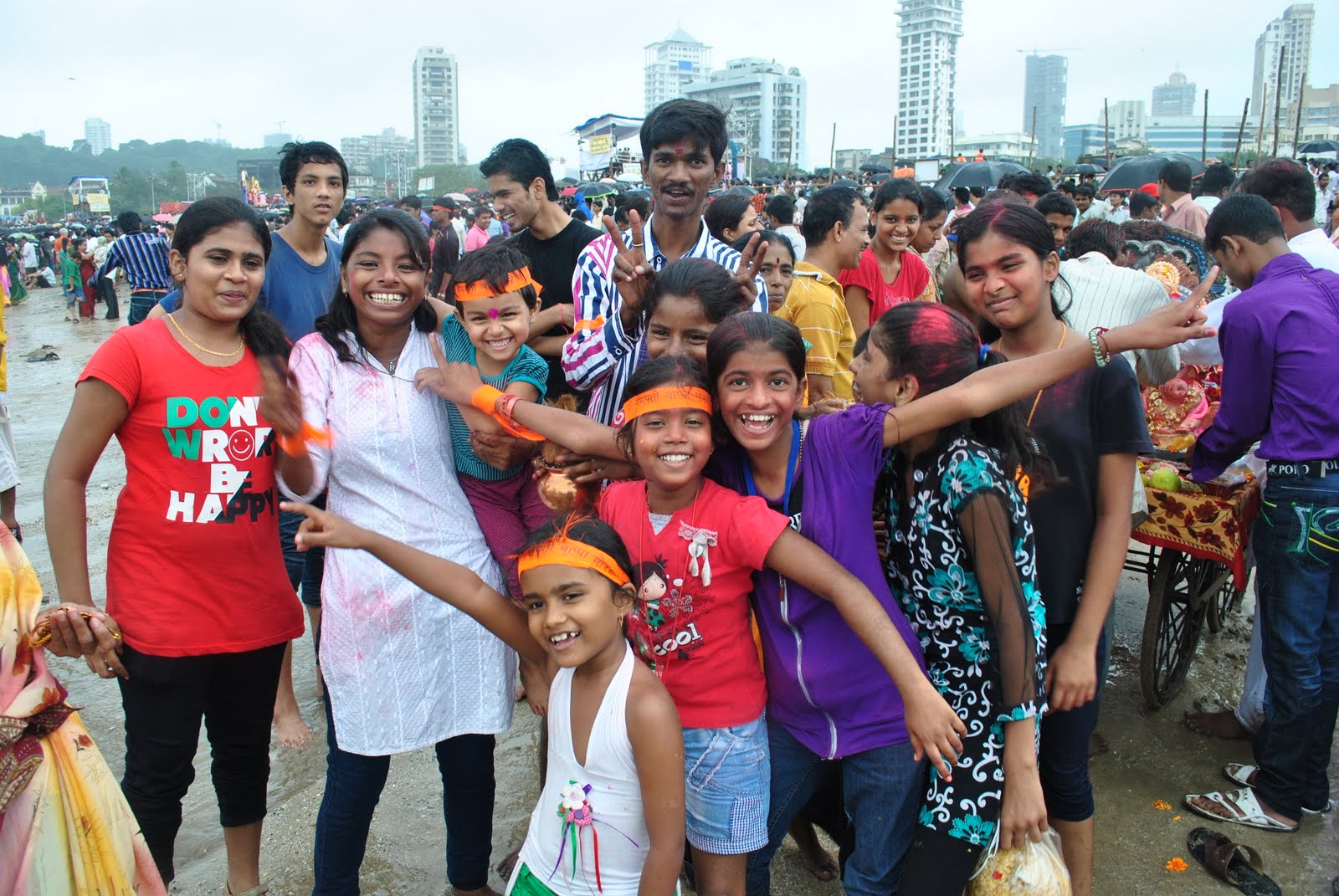
The other three are doing exactly the same thing and eventually we all come back together to compare images. Our cameras go away (despite the 7D being 'splashproof'), because the heavy rain had become torrentual. It made for quite an experience and I hope my videos come out.
----------
Dom:
Colour, drums, flowers, and figures of Ganesh filled the local streets as we walked the short walk along the prominade. People were dancing, cheering, singing and praying as we weaved our way through the festival goers. Hindu's young and old wanted to touch us, get their photo taken with us and to say hello. For a moment I felt a little like a celebrety but then I came back down to Earth, thinking less about how I felt and more about what I had been so lucky to stumble upon. Whether it was luck or good judgement the travelling film makers had managed to decend upon mumbai on the best weekend possible.
It's quite funny, the previous day I gazed into these unknown streets with worry and pity. Today however, all I see is love and a close knit community. The festival starts in each individual community , a single statue is constructed at its heart wherupon local people come to worship Ganesh in the days leading up to the drowning. On the day a flowered truck with masses of spectators tugs Ganesh through the streets. Celebrations carry on throughout the day before eventually making their way to chowpatty beach where high profile citizens carry the shrine into the sea. Bhangra music is blasted through the veins of the locals, acting as their alcohol, fueling them to dance the night away.
----------

George:
Ganesh's were drowning left right and centre as the horizontal, driving, pitiless rain sent wave after wave of over excited elephants straight into the brown frothing surf. Nobody seemed overly worried about getting wet but the view from the top of the beach was one of a sea of ineffective umbrellas. Families standing and watching for their own statues among the thousands present, all eyes turned seawards.
The rain was a pity for us because it meant that picture taking was rather limited. The cameras only appeared for the short spells where the torential downpour became slightly less torential, a few minutes at most. But when pictures fail, a soaking to the skin can really help to make you feel involved. Especially when people around you are so clearly not bothered as to be periodically flinging themselves into the sea.
Two large statues, several men tall, lumber past us on wheels not meant for sand. Three men stand on each daubed head to toe in red paint, desperately shouting above the wind to part the crowd in front, shouting directions to the men below on where to move the statues. Families stumble out of the way as the giant many handed elephants make their way to the water. Just like real elephants, no-one wants to get in their way but even so it takes a good 20 minutes for the first to reach the waters edge, and another 20 before they start to be submerged. We decide that if we wait any longer we might drown ourselves before Ganesh does and so it might be prudent to beat a retreat to dry land. As we turn to leave I'm struck by an amazing pun involving swimming trunks, but everyone looks a bit too soaked to care right now. Maybe later.
----------
Tom:
We finally made it back up the beach, having to turn down invitations to start dancing so we could find a place to eat. We found a place in quick time, Cafe Mondegra, a cheap place with western style decor and an old Gerry Rafferty hit playing out on the american style jukebox. The cricket score on the TV. Unfortunately no beer to swill down with our dinner of roast chicken today. Mumbai was a dry city because today was a holy day.
Filled up, and with a newly purchased, and what turned out to be vital, umbrella in hand we made it to the regal cinema to see what the Indian population passed off as entertainment. But as the two main titles were "Little Rascals" (Picture: Two Indian midgets), and "The Dirty Picture", we decided that the foyer of the picture theatre was far enough.
So for the third time in a day we jumped in a taxi to take us back through the crowds of ever massing people and trucks packed with happy worshipers, people even sitting on the rooves in the rain to get the best view of the occasion. By 7:30 the sun was going down and the beautiful Kamara Henru garden was the best place to witness the epic light show over Chowpatty beach.

-----------
Ewan:
Expecting baskets and other garden things of the hanging variety, (Kamara Henru litteraly translates as the Hanging Gardens), we were instead greeted by a very picturesque maze of pathways, defined by petit shrubbery and rose arches. By this point it was indeed getting quite dark and several fruit bats had taken to the skies above us, their huge black wings standing out from the grey clouds. They weren't the only things in the sky however. Huge mobs of hawks soared above the gardens in a dazzling aerial melee. The smaller bats made sure to weave out of reach of the hawks... just in case.
If this wasn't spectacular enough, then the view from the hilltop certainly was. I cannot tell you exactly how many people there were, but it must have been well into the hundreds of thousands. We all stared down to the beach where we stood earlier that afternoon, now nightime, onto the bulging swarm of humans below. It was like a helecopter shot of the crowds at Glastonbury Festival, only this streched for the entire length of beach.
Dom: "The night had decended but the party had only just begun. As we gazed through the opening in the trees down onto the beach, millions of people flooded the skyline. A shockwave hit all four of us at once. Utterly amazing."
Tom: "Huge bats darted over the opening onto the scene below. Thousands littered the sea, spotlights sweeping across the crowds. Loud bangs followed as fireworks lit up the sky."
George: "Festival doesn't quite cover it. The sheer number of people down below is unbelieveable. I've seen the crowds that turn out in Vatican City to hear the Pope speak and even they don't compare to this. Everywhere is full. The roads, buildings, beaches; everywhere. Everywhere is absolutely and completely full to bursting and nobody cares. The city is as alive as I imagine it ever could be."

We absorbed for a good half hour more before deciding to surrender the fantastic view to the night. We decended back down the hill, dodging the many celebrating locals as we went.
Back on the train, rocking back and forth, we reflected on the sights, sounds and smells of the day. All of us conceded, with big grins on our faces, that Mumbai had just laid down a trump card. Mumbai and it's people had shown their true colours. We all agreed that had it not been for Ganesh's brithday, we'd all leave Mumbai lacking a single good word to say about it. Now, we'll remember it for the rest of our lives, not just for the bad things, but for the amazing people that shine out of the depression.
George:
Monday, 12 September 2011
On Tuk Tuks
Tuk Tuks as a species are common all over South East Asia and the Subcontinent, but the particular breed you encounter seems to vary depending on where you are. Here in Mumbai, the ever present and friendly buzz of the multi-coloured Sri Lankan tuk tuk has been replaced by the deeper, throatier growl of an altogether meaner machine. Black and yellow three wheelers crowd the already overflowing streets, dirty exhausts spewing clouds of brown soot onto the tarmac. The drivers are uniformed, uninformed and unfriendly, constantly on their horns, weaving between lanes, trucks and busses with little to no regard for their passengers comfort or safety. A journey in a Mumbai tuk tuk can be...quite fun actually.

Unlike their Sri Lankan cousins the Mumbai tuk tuks are all of a kind, with the colour scheme covering taxis of all sizes as well as the tuk tuks themselves. There are no personal touches to the cabs, no stickers or slogans. All of them seem to come from the same mould, a world apart from the hundreds of brightly coloured, individualised tuk tuks of Colombo. No matter which cab you flag down every driver will initially charge you about double the price they will eventually settle for. As long as you're willing to walk away you can always find a tuk tuk cheaper, though the sheer amount of people here mean it might be a while before an empty one turns up.
Once on the road the only things available to secure yourself with are your own two hands. The roads in Mumbai are uneven at best, and the drivers don't slow down for the bumps so you need to be careful or you might end up with your head through the canvas roof. Cars cut you up at all angles and from all directions. It's a miricle there aren't more crashes than there are, the roads hold everything from 18 wheelers to ox carts. The varying speeds mean that lanes don't really play a big part. The traffic moves organically, flowing around blockages like a river would. It's a system that works quite well at keeping the traffic moving, but it can be a little terrifying when your tiny three wheeler suddenly veers diagonally across three lines of cars to avoid a rogue cow.
It's easy to see why the Sri Lankan tuk tuks wouldn't work here. There are simply too many people for a friendly aproach. Every walkway is crammed with people wanting a lift. It's impossible to move anywhere in Mumbai, a huge city incidentally, without being jossled and crowded out. All day every day is the equivalent of rush hour in London, so the concept of a relaxed journey anywhere is unrealistic at best. It will be interesting to see how the tuk tuks change as we move through India and into South East Asia, it seems reasonable to assume they'll be different everywhere we go, but different how we will just have to wait and see.
George
Subscribe to:
Posts (Atom)